
Blog
Astell & Kern PD20 Review

Verdict
The PD20 combines all of Astell & Kern’s longstanding understanding of electronics and metalwork with a freshly comprehensive suite of software that makes it a formidable option for headphone use on the move. It’s not cheap and it’s not small but the performance is good enough that many people won’t care
-
Superb headphone performance
-
Well-made and superbly finished
-
Flexible use options
-
Pricey
-
Large and heavy for portable use
-
Battery life in some modes is quite limited
Key Features
-

Review Price:
£1799
-
Storage
256gb internal storage expandable up to 2.25tb
-
DAC
Quad ESS DAC with twin headphone amplifier
-
Apps
Supports most major streaming services and Roon
Introduction
The market for personal audio players is a rather affair than it once was when the iPod dominated the business of listening to music on the move.
Astell & Kern has carved out a strong presence at the top of this more niche market and over the years, they have cleverly evolved their devices to be more than a portable device for use on the move.
The PD10 that I looked at in 2025 can deliver great performance over headphones or earphones but can then be parked in its supplied cradle and used as a superb source for your main system as well. It’s clever thinking and the PD10 is a superb product.
You might reasonably assume that a device called the PD20 would be more of the same; tweaked and improved but intended to offer the same dual use concept. The reality though is a bit different.
While Astell & Kern hasn’t abandoned the idea of being able to do more than use the PD20 out and about, it has revisited the functionality needed to make the PD20 a more effective partner for this primary role. As I shall cover, this includes functionality that hasn’t appeared on any Astell & Kern device up to this point as well.
As such, we need to see if this change in direction has yielded positive results and if the not inconsequentially expensive PD20 is the device you’ll want to turn to when it’s time to leave the house.
Price
The PD20 is available in the UK for £1,799. The dealer network isn’t huge but it covers most areas of the country and it is possible to purchased online if you are particularly remote. In the USA, it is available for $1,970 USD while in Australia, it will be $2,649.
Something that is important to stress is that the PD20 is not a replacement for the PD10. The two units will be sold together and this reflects the differences in specification and intended use between the two different models.
It’s also worth stressing that despite the higher number, the PD20 isn’t a higher specification device than the PD10 and indeed costs less.
Design
- Superbly made and finished
- A bit on the big and heavy side
- Revised external controls
- Clear and logical interface
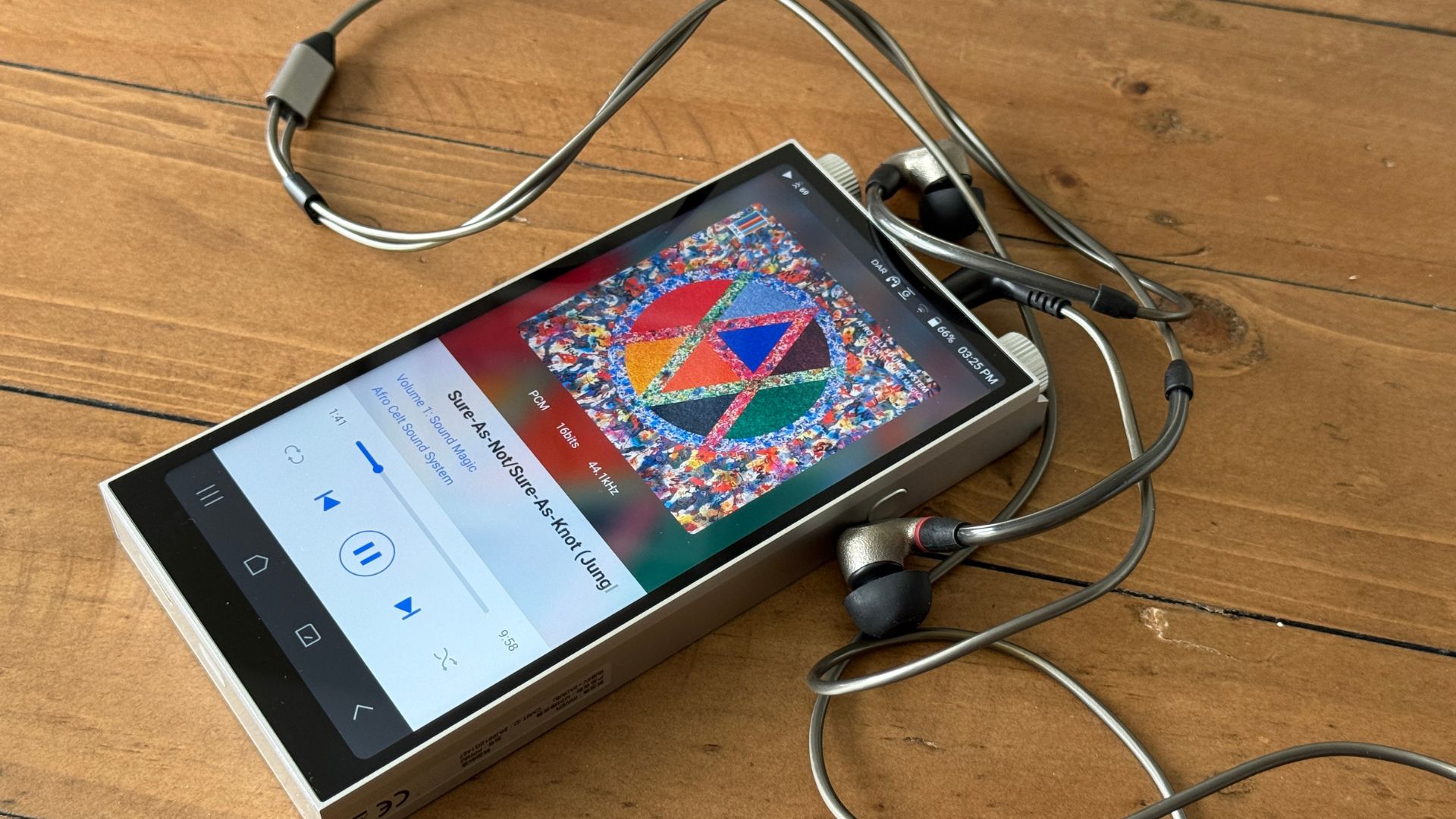
Those of you familiar with Astell & Kern’s handiwork up to this point won’t find anything alarming about the PD20. The all metal chassis is solid, weighty (weighty enough that any of you who go in for a loose fitting garment might want to check what happens if you put it in a pocket before you head out) and finished to an immaculate standard.
There are some intriguing differences between the PD10 and PD20 though. The PD10 streamlines the controls to a row of buttons down the side. The PD20 by contrast has rather more going on in the form of both a pair of rotary controls on the top to control both tone and volume and a row of switches on the side; the functions of which we’ll cover in the specifications section.

There is no getting away from the fact that the Astell & Kern is pretty big for a ‘portable’ device. This might be better viewed as something that travels with you in a bag and, even then, it had better be a reasonable sized bag.
The upside to this is that it means that Astell & Kern is able to fit a decent sized screen which is bright and easy to read. It wasn’t too long ago that even the premium models didn’t feel as responsive and easy to use as a middling phone. This is very much no longer the case.

The interface itself is also as good as I’ve ever experienced from an Astell & Kern device. At its core is a version of Android but a great deal has been changed and tweaked by Astell & Kern to better suit its more specialised use case. Key things like swiping down to access key settings and menus has been retained though and it makes the PD20 feel wholly unintimidating to use.
Final mention has to go to the packaging too. It’s attractive, brilliantly laid out and does a fine job of making you feel like you haven’t wasted your money. You get some screen protectors included but no case which is a slight shame as I’m sure that your first scratch will be a mortifying experience.

Specifications
- Limited internal memory with option to expand
- Quad DAC arrangement
- Adjustable amp classes
- New hearing test software and EQ
Like the PD10, the PD20 offers 256GB of internal memory which, in 2026, feels a bit on the parsimonious side.
Yes, you can add a micro SD card of up to 2 terabytes in size and these have become more affordable in recent years but if you use Qobuz or Tidal as your main source of material (both of which the PD10 supports natively), these files can only be stored offline in the internal memory which will quickly fill up.

At the best part of two grand, 512gb doesn’t feel like too much of an ask. As well as Tidal and Qobuz other streaming services can be installed and the unit can also used via Roon and Roon ARC as well.
The decoding is significantly different to the PD10 which used AKM hardware. Here, there are no less than four ES9027PRO chips fitted that sum their results against each other, looking for and then correcting any decoding errors.
This is a lot of processing power (each DAC on its own can support eight channels of information) and the quoted performance is impressive. The DACs are externally clocked and fronted by an Octo Core processor.
The PD20 supports PCM to 768kHz and DSD512. There is also DAR (Digital Audio Remaster) software; an upsampling algorithm that can be used in PCM or DSD versions (and, no less importantly, can be switched off).
If you do run it, the sample rate increases considerably, with Astell&Kern stating that this allows for additional information to be interpolated and worked into the output. This is combined with six adjustable digital filters that adjust the roll off rate and amount of pre ringing.

The digital stage outputs to an internal amp that works a little differently to both the PD10 and indeed other Astell & Kern models. On the side of the casework you’ll find two three-position switches. The first allows you to switch the topology of the output between Class A, Class AB and Hybrid – intended to combine the benefits of both.
A second switch changes the amp current settings between high, medium and low, depending on the headphones you are using. This gives the Astell & Kern the notional ability to power some very demanding headphones indeed although if you run it in Class A mode and the high current setting, the battery life will be limited.
At the top of the chassis you’ll find both a 3.5mm and 4.4mm output for balanced and unbalanced headphones and these are coupled to a 150 step volume control which can be bypassed if you put the PD20 into line out mode. It also has an entirely effective two way Bluetooth implementation too. It’s still perfectly possible to use the Astell & Kern as a compact digital source for your system if the fancy takes you, even if the neatness of the PD10’s dock is absent.

So far, these are only minor changes from the PD10 but at this point, the PD20 starts to differ significantly. The PD20 is fitted with software that Astell & Kern has developed with Audiodo to perform an interactive listening test on your hearing and adjust the output of the PD20 based on your feedback.
Running the test takes less than five minutes and you can store multiple profiles on the device as well. In order for this result to be consistent, you’ll find a small pair of earphones in the box to run the test with that ensures the results will be consistent.
This is partnered both with tone control adjustment and an on board EQ to further tweak the performance to your needs. This is by far the most flexible and customisable Astell & Kern device I’ve tested and it should allow the PD20 to match up with pretty much any headphone and then adjust what it’s doing to suit your needs. Neither is it done there.
There is also software called Audiosphere which Astell&Kern claims ‘goes beyond conventional stereo, delivering a powerful sense of spatial immersion. It expands two-channel audio into a virtual three-dimensional sound field and offers four presets.’ I have to say it’s an acquired taste in use but it’s there if you want it.

Performance
- Capable of excellent performance even with no EQ engaged…
- … but it gets better still once you do
- Switchable amp modes have less effect
- Capable used as a line level source
Something that is very important to get across about the PD20 is that the new suite of software isn’t something that it ‘needs’ to have engaged to deliver a decent performance.
Leave it switched off, the EQ set to flat and none of the upsampling engaged and this is still a superb piece of audio equipment. Using it as a Roon Endpoint and sending it random corners of my music library did nothing to unsettle it and it’s as happy with the scuzzy shoegaze of New Meaning by Tempers as it is with the sublime high res of Sarah Jarosz’s Blue Heron Suite.
It’s tonally accurate and impressively good at keeping a feeling of space and three dimensionality in what you are hearing, even when you are using earphones.

If you do take the time out to run the hearing tests though, it does have a meaningful effect on the performance. For my sins, I am 45 and while I have looked after my hearing as best as I can, I am undoubtedly experiencing some rolling off at higher frequencies. After the tests had been run, there is a little more treble energy to the lovely Hallucinating Love by Maribou State that makes it a little more vibrant and exciting without it tipping over into being bright or harsh.
Something I found interesting is that I’ve lost a fraction more of the high end registers in one ear than the other and the test resulted in a gentle rebalancing of this which ensured the performance had a greater sense of stereo to it.
I was a little concerned that this would in turn affect adding crossfeed to the signal (as what was being transferred to the other channel would be boosted over what that ear ‘needs’ but I needn’t have worried and I still preferred the performance with some crossfeed engaged.

Against this, I have found the amp modes to be less profound in what they do. This is partly down to the reality that none of the headphones and earphones that live here are very hard to drive so the extra current on offer doesn’t have a night and day effect but, even allowing for this, I suspect that the digital tweaks will make more difference for most owners than the amp mode switches which I suspect will see less use once some initial tinkering has taken place.
There is also the good news that, while the PD20 doesn’t feel quite a slick to use in a fixed installation as the PD10, it’s still capable of delivering a truly satisfying performance.
Listening to Boards of Canada’s mighty Prophecy at 1420MHz via the PD20 captures the shifting and positively unsettling power of the work, the immediacy and scale it has and the intricate details of the samples are well worked into the main system.
The PD20 feels less a portable audio source than the PD10 but it doesn’t prevent it from being entirely effective used as one.
Should you buy it?
After a few years showing that their products could be more than a portable player, the PD20 feels like a revisiting of the concept. The extra software fitted means it is more flexible and capable of delivering a sparkling performance with pretty much any headphone or earphone at home or on the move.
This is still a big, heavy and expensive way of listening to music on the move and, as we head into summer with fewer pockets to hand, many people will find the PD20 simply too big and pricey to relax into using it out and about.
Final Thoughts
This isn’t a replacement for the PD10 and neither is it a clear cut higher spec model either.
What it is might be best seen as a considered take on what a high spec portable player needs to be in 2026.
The overlapping nature of the Astell & Kern range means that this here to be a viable option for headphone only customers who might have been feeling left out by the system integration efforts of the PD10.
How We Test
We test every portable music player we review thoroughly over an extended period of time. We use industry standard tests to compare features properly. We’ll always tell you what we find. We never, ever, accept money to review a product.
Find out more about how we test in our ethics policy.
- Tested for several days
- Tested with real world use
Full Specs
| Astell & Kern PD20 Review | |
|---|---|
| CPU | Octa-core |
| Manufacturer | Astell & Kern |
| Screen Size | 6 inches |
| Storage Capacity | 256GB |
| Expandable storage | Up to 2TB |
| Battery | 5770 mAh |
| Size (Dimensions) | x x INCHES |
| Weight | 313 G |
| DAC | ESS ES9027PRO x4 |
| USB DAC Mode | Yes |
| Release Date | 2026 |
| Resolution | x |
| Connectivity | Wi-Fi, Bluetooth 5.3 |
| Colours | Silver |
| Audio Formats | WAV, FLAC, WMA, MP3, OGG, APE, AAC, ALAC, AIFF, DFF, DSF |
| Touch Screen | Yes |
| USB charging | Yes |
| Inputs | USB-C |
| Outputs | Unbalanced Out (3.5mm), Optical Out (3.5mm) Balanced Out (4.4m, only 5-pole supported) |
| UK RRP | £1799 |
| USA RRP | $1970 |