
Blog
Fujifilm X Half Review

Key Features
-

Review Price:
£549
-
1-inch sensor
The vertical 20MP 1-inch sensor captures 3:4 images by default.
-
Analogue-inspired shooting
Comes with 10+ Film Simulation modes, diptychs and a dedicated Film Roll mode.
-
Lightweight retro design
240g with a pocketable body and quirky controls.
Introduction
The Fujifilm X Half is one of those cameras that looks like it should be a niche oddity – and, in a way, it is.
But it’s also the kind of camera that leans so fully into its own concept that it starts to make a lot of sense, especially if you’re after something more playful and characterful than a conventional point-and-shoot.
It borrows the feel of half-frame film cameras and mixes it with a handful of genuinely fun digital tricks, resulting in a camera that’s less about outright specs and more about the experience of using it.
Of course, that also means making a few compromises along the way, but as I’ll get into here, the X Half’s charms go a long way in making those easier to forgive.
Design
- Retro, lightweight, and surprisingly pocketable
- Quirky controls include film lever
- Portrait-oriented dual rear screens
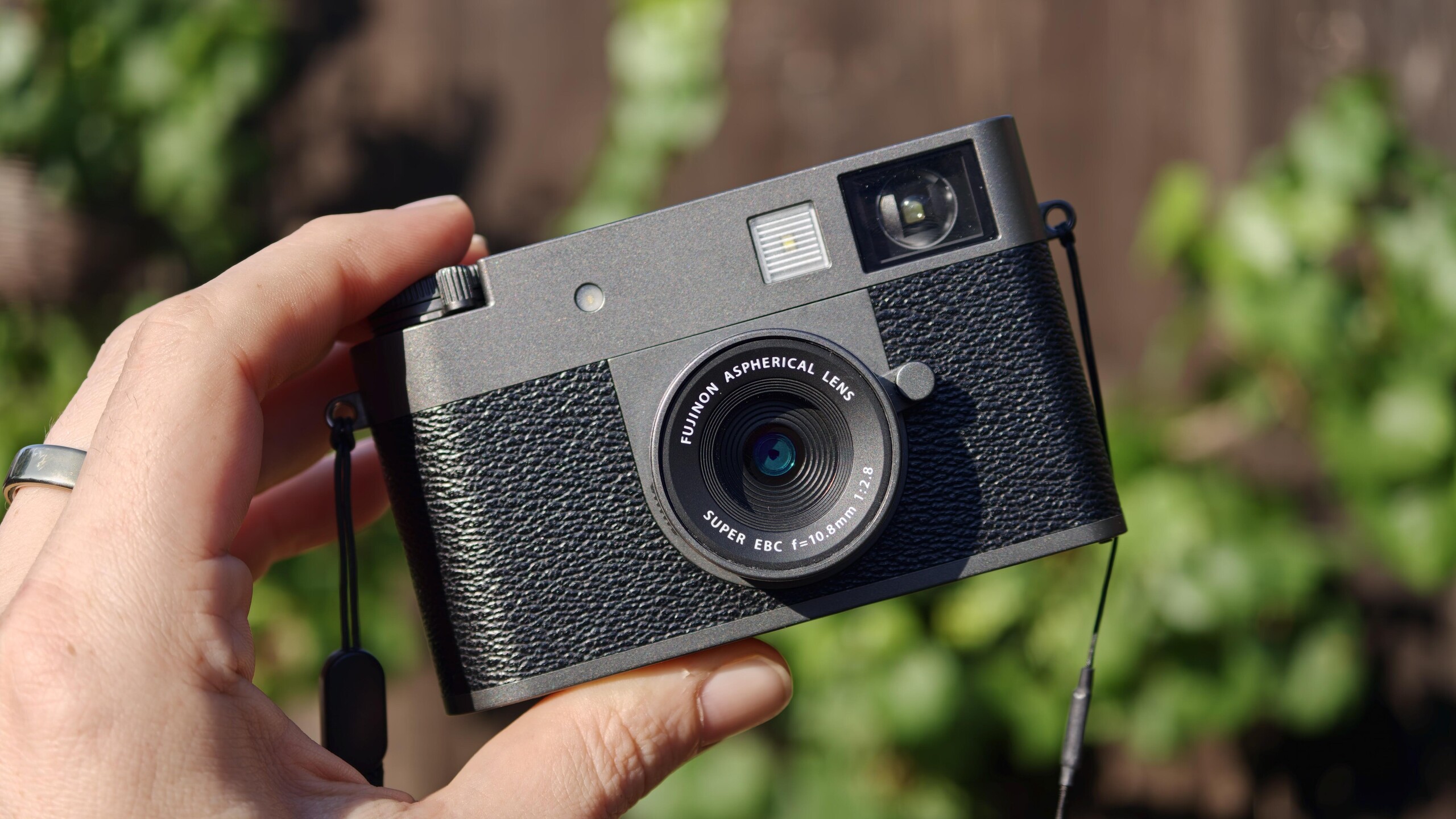
The Fujifilm X Half goes all-in on the retro styling, sharing certain similarities with other cameras from the brand, including the iconic Pentax 17. It may have an entirely plastic frame, but it doesn’t feel cheap in the hand in the same way that truly affordable cameras like the CampSnap CS Pro do. There’s some weight to it, but at 240g, it’s still a lightweight unit compared to ‘proper’ mirrorless and DSLR cameras.

It’s also surprisingly pocketable, and I can’t remember the last time I said that about a semi-serious camera. That’s helped by the tiny 32mm-equivalent focal length fixed lens that doesn’t protrude far from the body. Flanked alongside the lens is a mechanical aperture adjustment lever, which can be manually adjusted from f/2.8 to f/11.

Staying with the controls for a second, there’s an on/off switch on the top of the camera that, when set to on, makes the film-wand lever pop out. It’s, of course, not actually moving the film as it would on a traditional film camera; instead, it’s used to activate the camera’s diptych feature or move onto the next frame in the dedicated Film Roll mode – more on both of those a little later.
The shutter button finds itself nestled within the exposure compensation dial on the top-right of the camera. It’s certainly a choice, but given the compact nature of the camera, I get it – and it actually makes it easier to adjust the exposure without having to take your eyes off the viewfinder.

Next to the shutter button and exposure dial, placed centrally on the top of the camera, is a cold shoe for mounting accessories. It’s not a hotshoe, so you won’t be able to use connected accessories like a flash gun, but there is a small LED flash sitting above the lens that helps add some fill light for darker environments, toggled on or off via a dedicated switch on the left side of the camera.
At the bottom of the camera, you’ll see a compartment for the W126S battery that powers the camera. Fujifilm claims it’s good for up to 880 shots on a charge, and while I didn’t take quite that many in one go, it always had plenty of charge whenever I reached for it over a review period of a few weeks.

But it’s when you look at the back of the camera that some of you might be confused; there’s a basic look-through optical viewfinder in the top-left, along with not one but two screens, a toggle for stills and movies, and a play button – but not much more. Where are all the controls, buttons and dials you’d usually expect to find on a camera like this? Well, that’s where the X Half gets interesting.
You see, the X Half doesn’t just want to look like a retro camera – it wants to operate like one too, albeit with a digital twist.
The smaller of the two vertically-oriented screens on the far left is there primarily to mimic the film canister window you’ll find on many film cameras, with a swipe up or down on the touchscreen taking you through the 10 analogue-inspired Film Simulation modes. However, it can also be used to adjust camera settings in certain modes and act as a navigation tool when browsing the, at times confusing, settings menus.

The bigger screen of the two is the one you’ll be using most often. Unlike most cameras that have landscape screens, this one is portrait-oriented to better suit the camera’s 3:4 native aspect ratio. It’s not the biggest screen around, measuring at 2.4 inches, though it’s the way that you’ll frame your photos most of the time when using the camera.
Why? Even though there’s an optical viewfinder, it’s aligned to the left of the camera, while the lens is centrally placed. That essentially means that there’s a slight difference in composition between the viewfinder and what’s captured by the lens – it’s not a big deal for wide vistas, but for portrait shots and the like, it can mean the difference between your subject being perfectly centred and positioned to the right of the frame. As such, the digital preview is essentially the ‘true’ preview of the shot.

It’s a shame, then, that it’s not that bright. It was fine indoors and on cloudy days, but I could barely make out the details on the screen on a truly bright, sunny day while wandering down by the River Thames. It’s also a little bit fiddly to swipe between the various settings menus, as it’s not quite as snappy and responsive as I’d like it to be.

Features and performance
- Vertical 20MP 1-inch sensor
- 10+ analogue film simulation modes
- Fun, screenless Film Roll mode
There was a bit of a disparity between the price of the Fujifilm X Half and its launch price – at £649/$849, it was just a little too expensive for the cut-back experience compared to cameras of a similar cost. However, the camera has since dropped to £549/$649, with recent sales seeing it drop as low as £429/$599 – and at that price, a lot of the earlier complaints are much easier to accept.
That said, if you’re looking for a new primary camera, this probably isn’t it – it doesn’t offer a lot of control over your shots, video is capped at Full HD and 24 fps, and there’s not even support for RAW capture – but if you’re looking for a point-and-shoot camera with some personality, the X Half has that in excess.

The portrait-style photos and videos are captured by a vertical 20MP 1-inch sensor with a 2:3 aspect ratio, though the output is 3:4, so the maximum photo resolution is actually a little lower at 18MP. Combined with the 32mm-equivalent focal length, it’s a great perspective for everyday snaps – and especially if you’re big into social media.
The default portrait aspect ratio works extremely well for Instagram Stories, TikTok videos and the like. You can take horizontal shots, but you’ll need to rotate the camera yourself, and without a built-in gyro, you’ll need to manually rotate those shots after. But still, it’s possible, even if it’s not always convenient.
Still, for a camera of its size, the results are pretty impressive; the f/2.8 aperture delivers a nice bokeh on close-up images, especially when you get close to the minimum 0.1m focus distance, and the 32 mm-equivalent focal length is great for street photography. It’s also quick to focus, with a face-detection autofocus that helps keep portrait shots nice and sharp, with a couple of different AF options for more general use.
Nighttime performance is pretty solid with the 1-inch sensor and wide aperture, drinking in plenty of light, even when left in its default automatic mode. However, the built-in flash can sometimes be a little too bright for the situation, blowing out faces and other highlights in darker environments. Still, even those shots have character and, dare I say, charm, reminiscent of the same problem we had with cheap disposable cameras in the 90s.
But with the X Half, it’s not just about how detailed the shots are; half the fun is in deciding on the overall look of the image, with various analogue film simulations on offer. With a quick swipe of the smaller vertical screen, you can switch between 10 popular Fujifilm canister styles, be it the vintage cheap print film roll of Classic Neg or the punchy contrast of the Eterna Cinema, each with its own signature look.
There are also some additional picture effects that can be enabled from the camera’s menus, including rather gimmicky mirror and toy-camera effects, to slightly more interesting options like light leak. Again, leaning very much into the nostalgia of early film cameras here.

That also applies to the diptych feature I mentioned earlier, which essentially puts two 3:4 shots side-by-side, just as an analogue half-frame camera does on a roll of 35mm film. But as it’s digital, they’re not actually half-sized like the inspiration – they’re full-size 3648 x 4864 images, with an overall resolution of 3648 x 4864 with a 3:2 aspect ratio.
It’s not to my tastes necessarily, but it’s easy enough to use if it is something you want to experiment with; just like on the analogue inspiration, you simply pull the film wand lever.

My favourite feature of the X Half isn’t a shooting mode or a filter, but rather an experience; Film Roll mode. And, if like me, you have fond memories of analogue cameras, be it high-end models or cheap disposable film cameras from the 90s, you’re almost guaranteed to love it.
Why? Because as the name suggests, it simulates the analogue film roll experience. You choose the film simulation you want, the number of frames in the film roll – 36, 54 or 72 – and then you’re locked into those settings until the virtual roll runs out, just like with its analogue counterpart. You even need to crank the lever to move onto the next frame.

Even the display switches off, forcing you to use the optical viewfinder, with the screen instead only displays the number of shots left on the roll. There’s no way to preview the images until you download the roll onto the companion app for iOS and Android and digitally ‘develop’ it either – only then will you see the shots you’ve taken.
This might sound like a bit of a headache for pro-level photographers – and it very much is – but that’s also not the point of the X Half. It’s a nice hat tilt to an earlier, arguably simpler time for photography, where it was all about in-camera composition and not aggressive post-production.
The X Half is more about capturing memories with a bit more personality than you’ll get from a mirrorless camera or smartphone, rather than capturing the absolute perfect shot. And at its now-cheaper price point, that’s absolutely fine.
Should you buy it?
You want a fun analogue-inspired shooting experience
The Fujifilm X Half leans hard into the charm of half-frame film cameras, with Film Simulations, diptychs and a screenless Film Roll mode that make it feel more playful and considered than a typical point-and-shoot.
You want a serious primary camera
With limited manual controls, Full HD 24fps video and no RAW capture, the X Half is better suited to casual, characterful shooting than replacing a more capable mirrorless or compact camera.
Final Thoughts
The Fujifilm X Half won’t be the camera for everyone – but that’s also not really the point.
It’s a charming, personality-filled little shooter that leans hard into nostalgia, and if you’re happy to trade a little control and outright image quality for a more playful, more considered shooting experience, there’s a lot to like here.
At its now-cheaper price, the X Half makes a much stronger case for itself than it did at launch – and for the right kind of user, that may be more than enough.
To see how it compares, take a look at our selection of the best cameras around in 2026.
Trusted Score
How We Test
We test every camera we review thoroughly. We use set tests to compare features properly and we use it as our main device over the review period. We’ll always tell you what we find and we never, ever, accept money to review a product.
- Used the camera for two weeks
- Tested indoors and outdoors in bright and dark conditions
FAQs
Not especially. The Fujifilm X Half can record video, but it’s capped at Full HD at 24fps, so it’s better suited to quick casual clips than serious video work.
No, and that’s part of the point. Film Roll mode switches off the display and only lets you see your shots once you’ve finished the virtual roll and digitally developed it in the companion app.
Trusted Score
The post Fujifilm X Half Review appeared first on Trusted Reviews.